Here is an summary breakdown of the two accepted papers resulting from the HARMONIA Berlin School collaboration:
1. Dust Radiative Effects and Impact on Energy Production over the Mediterranean Basin
Authors: D. Kouklaki et al.
Focus: Investigation of solar radiation attenuation and photovoltaic (PV) power losses during severe dust events (2021–2022) across Mediterranean sites.
Key Findings:
Direct Normal Irradiance (DNI) attenuation frequently exceeded 60–80% during peak dust events.
PV power output losses reached up to ~45% for fixed-tilt systems and ~80% for 2-axis tracking systems.
Solar Zenith Angle (SZA) and Aerosol Optical Depth (AOD) are the dominant factors influencing solar energy production losses.
2. Source-Dependent Optical and Mineral Signatures of Dust Outbreaks over the Mediterranean
Authors: A. Papetta, C. Herrero del Barrio et al.
Focus: Tracking four major Saharan and Middle Eastern dust outbreaks using multi-platform observations (AERONET, satellite, in situ UAVs) and numerical modeling (METAL-WRF).
Key Findings:
Saharan dust is dominated by coarser, strongly scattering particles.
Middle Eastern dust exhibits finer, more absorbing characteristics due to mixing with anthropogenic aerosol pollution.
Optical variability across the Mediterranean is driven primarily by the dust-to-total aerosol mixing ratio rather than mineral composition differences alon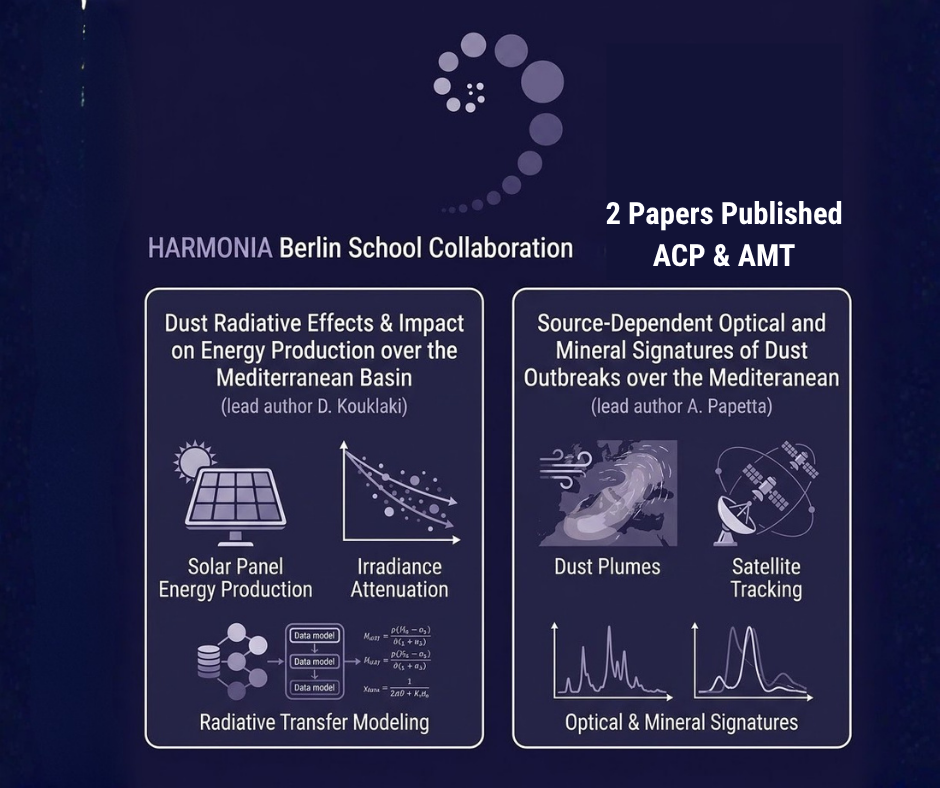

NEWS
09.02.2026